This is the fourth in a series of five posts on the journey of unlearning roles and life-scripts that interfere with effective leadership and personal fulfillment. If you like, you can hear me read this post.
The other posts are:
In the last two of these I have suggested a fairly logical approach to separating from the roles by first describing and naming them, and then assessing their costs and benefits. But this barely scratches the surface, and may not “loosen” the script from the person sufficiently to effect real change. Transcending a role depends on recognizing its fundamental untruth, and the untruth of the behaviors that support it. For example, if I clearly see myself repeatedly playing out the role of “weak prince” in a series of jobs, seeing it also in my current COO position, I still may not be able to free myself. Even if I look hard and honestly at some of the behaviors that are tied to this role, such as blaming others for my inability to create change, making promises I cannot keep, or giving away my authority, I cannot simply snap my fingers and exit the role. This is because the role has some benefits (well, I do get to be a prince, after all) and it is ingrained, meaning the role is a very familiar pathway for me. It’s part of my comfort zone, and it is also at least partly unconscious.
If I do want to go deeper, I can do so through a process of creative reflection. I invite into awareness what the behaviors and the role they support mean about how I see myself, and how deep these beliefs go. To get to this level requires more than logic. It requires astute self-observation and the personal will and openness to discover what is as yet unknown to me. For example, as weak prince, I might notice how personally powerless I feel; how envious I am of those with more charisma. I might notice how dishonest I am with others and then reflect on how dishonest I have been with myself about my effectiveness. I begin to ask myself with a kind of ruthless curiosity how I actually see my self in the world. As I pursue this inner space and meaning, I increasingly become a mirror for myself. It’s not at all unusual for things that are happening in the world to suddenly become better mirrors to me, too. This is a matter of synchronicity.

I realize more fully than ever that if I maintain my underlying beliefs, I will continue to play the role in a patterned and unsatisfying way. The role, like a mask I can’t take off, will be living me rather than the other way around. This is the jumping off place into more important reaches of reflection. In fact, without the next leap, nothing is likely to change, for the next move is to invite the unconscious or subliminal content of the role “right into the living room” of awareness, to make a space for it. This can be done in a myriad of ways, all interpretive, all symbolic in the beginning, but later, with increasing evidence, into a firm understanding of the role’s nature and essential untruth. The role and how it is played out begin to look like a treasure chest partly buried in the sand. If it can be fully dug up and opened it will reveal a fortune in jewels.
The “myriad of ways” is primarily artistic. But not in the sense of accomplished or refined art; simply as a means to offer otherwise unconscious messages a better chance to make themselves known. This is entirely without regard to the “skill” level of a person. Painting, music, poetry, (even blogging!), undirected journaling, “guided meditation,” dream analysis, and meditation — all these and more may be effective so long as there is the clear intention to explore in depth the nature of the role, whatever it is. The weak prince, might creatively decide, for example, to write himself a series of letters from an unnamed “king.” All this is completely imaginative but often quickly reveals that there are messages to be received from an unknown source, a psychological “you’ve got mail” from an unknown sender (who turns out to be you). And so, in a way, the real person dealing with the role dives headfirst into the pool of what is meaningful, although not necessarily linear or logical.
Any tool may be used, as long as it represents the creative voice of the role coming forward. My personal example is the book of meditations and photographs I offer in the right sidebar, called This Raft of Self. In it I explore the role of “the Ferryman” and come to a realization about how that role fragments me. The process is one of taking my gifts for writing and photographs and literally diving into the role; exemplifing the role through this piece of work. And that, I believe, is exactly the path. Be the role in a highly creative way so that what becomes clear are all its boundaries and constraints, and perhaps its drama, too — though that may be more about me that you!
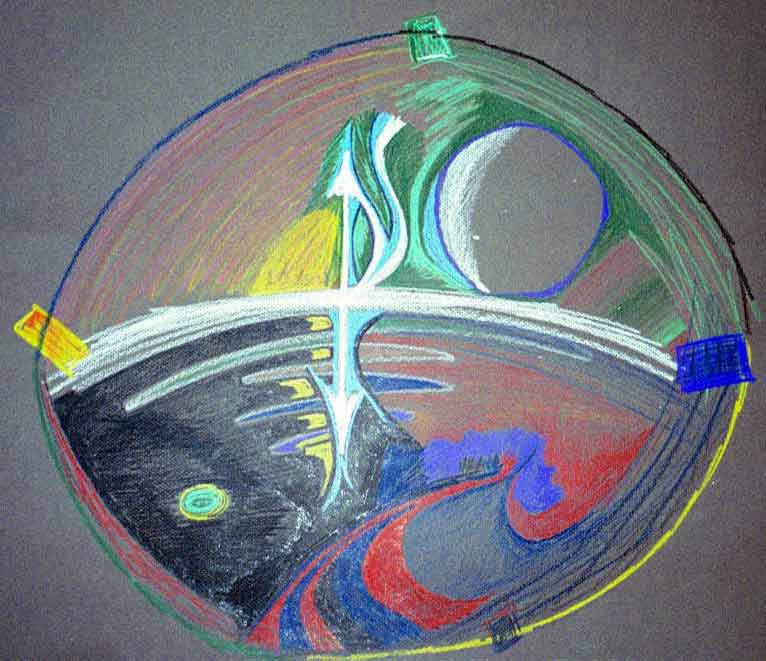
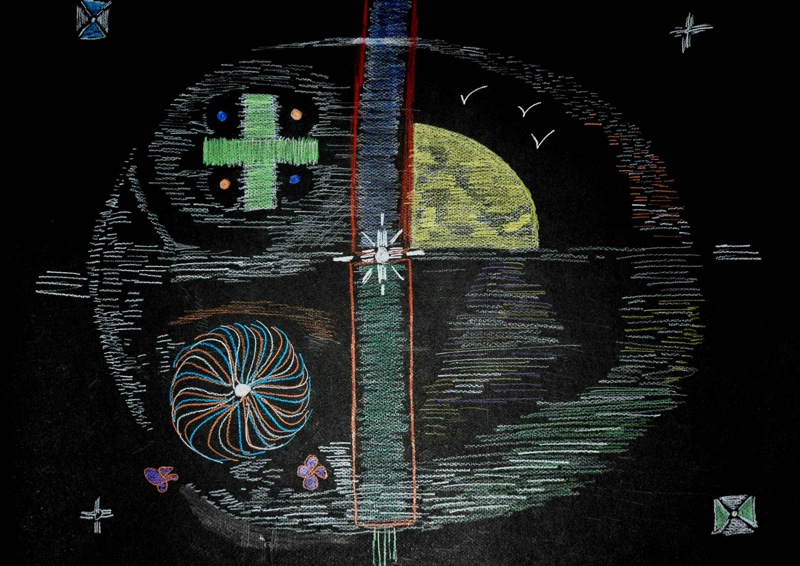
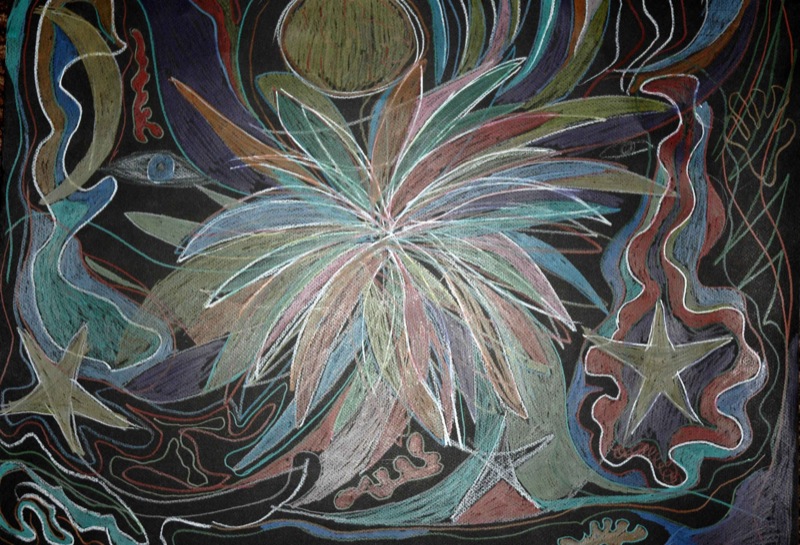
Let me share just one example of what I mean regarding creative reflection. At co-facilitated workshops in the past, I have asked participants to each draw a mandala, using Judith Cornell’s beautiful book
Once they had created their mandalas, we then asked participants to explain their drawings to one another. Amazing discoveries have often come out of this process. A candidate for presidency of a community college saw how small he made himself in comparison to his world. The leader of a social services agency saw her need for control in the fence she’d drawn around her current role. And a manufacturing manager tearfully discovered that he couldn’t “outfox” the exercise — one that he thought was “nonsense” — for what he soon saw in his random scribbles was how he had unconsciously drawn a picture of his own family members and the emotional distance he had moved away from them.
The messages were all there, but something else was present: a community of people, all similarly engaged in self-learning, to help interpret and offer feedback. Without that community, my belief is an individual can easily get lost or stuck. It’s not impossible for insight to come while alone, but the process is likely to move much faster when a variety of other viewpoints implicitly challenge the absolutism of the role and the beliefs beneath it. The roots of these scripts, I am convinced, are unknown to us unless we dig them out of the ground, and we can almost always use some helpers for that work.
The beauty of this artistic self-discovery process lies in the fact that the drawer and what is drawn are not different. In this way a mandala — or a poem or a photograph — can become a revelation. Because all roles represent reductions of a human being, the message is universal: you are not just x, whatever behavior or role is called out. X by itself is untrue, sometimes even ludicrous. You are not, weak prince, without charisma (however unformed it is today); you are not, candidate for presidency, too small for the job; you are not, disconnected manager, too far from your family (though you may need to take action lest you lose them — “And look here, you’ve drawn a vine that still connects all of you — tell me, what is that vine?”). These messages are not just intellectual ones. Those were apparent from the beginning. These are the emotional and spiritual messages, just out of awareness, that are finally capable of penetrating the essential woundedness of our underlying beliefs. In a moment, the beliefs can bring up all their numbed-out pain and also reveal their essential fiction. The essence of this journey is the unlearning of a self that no longer works. The mandala often displays both the life script and the doorway out.
I recall a workshop in which someone pointed out to another participant that a particularly firm line in her mandala looked like it was immutable, as if there was no escape from the life she had drawn. At this the participant bristled and became angry, but not at the other participant, just herself. She could see immediately, visually, how she’d allowed old hurts to contain her life in a way she no longer wanted. That moment more than shifted her entire experience of herself at the workshop. It was an moment of disruption, of dislodging a boulder, of moving out of an old self.
For those of you who may be skeptical, please feel free to hold onto your skepticism. This process, precisely because it is organic if not a little magical, does not work every time for every person. This is not a machine, not “software,” only a principle of inner exploration. Whether the application of that principle will pay off depends on many things, including the readiness of a person to allow the messages and their interpretations to come through. And if not today; if not with this particular medium, then another.
It should be pointed out that all messages from the unknown, those that come up “out of nowhere” in the process, and those that may be received from a member of a learning community, must still be tested against reality. Ultimately, the measure of the effectiveness of the method is whether a person experiences a higher degree of freedom and self-affirmation while retaining a strong groundedness in “what is.” The test, in fact, is whether one is released from fantasy. This means the weak prince might discover for himself that:
…I have power above and beyond cleverness
…I have a presence I am just beginning to understand
…I am not essentially weak
…I am operating in a complex world, not a purely treacherous one
And most importantly the message is that “I am not the weak prince I thought I was. I play that role only if and when I choose. I retain my skills, but am able to open into new possibilities. I am free only if I give up the ‘inflation’ of believing I am a prince — who was I ever to think I was one?” There may be clues here why simply focusing on positive self-messages in personal learning processes is not enough. We cannot overturn the hidden voices of our roles by simply singing to ourselves louder about how good or deserving we are. We must first see through the old songs, see how partial and even empty they truly are, while acknowledging their necessity to growth. Indeed, when discovery comes, we see immediately how an old role has helped us, even protected us against things that were too big to deal with from any other standpoint, how it was a way to illuminate and deploy our emerging gifts. We are grateful for the help the old role provided, in the way we might be grateful for a crutch that helped us get through the world while injured. And we are also grateful for knowing that we have another life to live.
The psychology involved here is based in Jungian views of complexes and the founding patterns of human experience called archetypes. What’s most important about this terminology is that it lets us understand how to build a bridge to freedom by learning how to stand at the portal between unknown and unconscious worlds and known, conscious ones. And having escaped old roles, which are really a form of possession by what is unconscious, we are now ready to open up our lives in new ways.
However good that moment of self-discovery is, it often brings up another profound question: if I am not that, what in fact am I? We wait at that moment for what J. Krishnamurti
More in the next and final post in this series on the journey of unlearning.

I am so glad to see you back, and thanks for your comment on my blog. My goodness, but you have been engaged! I will read with interest this and your previous posts, James Hillman and Jung fan that I am. All the best.
Thank you, Karen, all the best in your new job. The weather in Vermont sounds like a sign of the times.…