Hear me read this post.
A few days ago I posted a few “reflections,” which I described as a little less than full-fledged meditations and a little more than thoughtful prose. Hmmmm. I’ve been thinking about this definition, and also about why reflections might be valuable to anybody as they consider ways to strengthen their leadership capabilities. Let me share some of these thoughts and then I want to offer one more reflection on “whole-heartedness” — based on the ancient Chinese symbol for Yin and Yang and its implications for self-study.
 To me there is a real art to reflecting. It is the art of listening within. A good reflection isn’t quite yet the answer to one’s problem, but it can be the portal to that answer. Let me explain. A colleague I coached a few years ago was struggling with her career direction. She could leave her job to find another company. She could ask for a position of higher responsibility within her current company. She could make the leap to consulting. These were her choices and she was also grappling with the grief of losing a parent. Her energy was constricted and she was circling but couldn’t find the right place to land. Somehow, she had to figure out a way to loosen up and let an answer come to her. Over and over in our conversations she seemed to come back to the question, “What should I do?” But one day the air seemed to clear a little and question transformed itself into “What do I want to do?” That tiny breakthrough made things much easier. It was the right question. If I were going to write a reflection for her about this shift, in shortened form, it might look like this:
Everyday I wonder what I should do. All my choices bring their rights and wrongs and all of them have to have their day in court. They are clamoring for an answer. How am I to make this judgment? Without warning, something goes off in my head. Whereever it came from, this thought redefines me. Suddenly, in a quiet room, I take my time to practice this question again: What do I want?
The reflection is like a personal history of thinking and feeling, with a good question at the end to signal the very place where both an opening and a “stuck point” occur. We do not yet have the answer, but we do have the right place to wait for its coming. It is one thing when, as if in a dream, we do not know at all how to get out of town — or that we must — that’s really stuck. It’s quite another to be consciously waiting for a train that hasn’t quite arrived at the station.
(And by the way, the person I coached now does occupy an expanded role at her company).
I believe the value of these reflections can be enormous for any of us. They require slowing down the racing processes of thinking and feeling. This builds consciousness so that everyday dilemmas and conflicts are not “acted out” but deliberately attended to. In my experience, when people don’t bring the right reflections to consciousness they end up yanked along by their untended feelings rather than making more deliberate choices. And this can have a dramatic effect on their relationships at work. People under stress, attempting to solve inner questions that lie outside awareness, often turn their “shadow” sides to the world. They can become impatient, blaming, dismissive, mistrustful, and judgmental, spawning in turn these same qualities in others. They may do things, like make comments that are insulting, as simply a way of displaying the stress and leaving clues for others — sometimes very painful ones — that an inner conflict is out of control. The circumstances being faced certainly may be quite stressful, but the real stress may actually be coming from the unanswered questions on the inside. If I am struggling with knowing just what to do to become successful, for example, I may become very defensive about my performance, taking things very personally or reading into others’ behaviors all kinds of motivations that just aren’t there.
These inner insecurities are not a problem, they are an opportunity, but they require time and attention and willingness to search within. Not all stress is inwardly caused, but I sense much more of it is inward than most of us like to acknowledge. For an additional perspective on some of these ideas, you might want to take a look at the Slow Leadership blog. It is premised on the need for “slowing down” as a specific strategy for improving businesses.
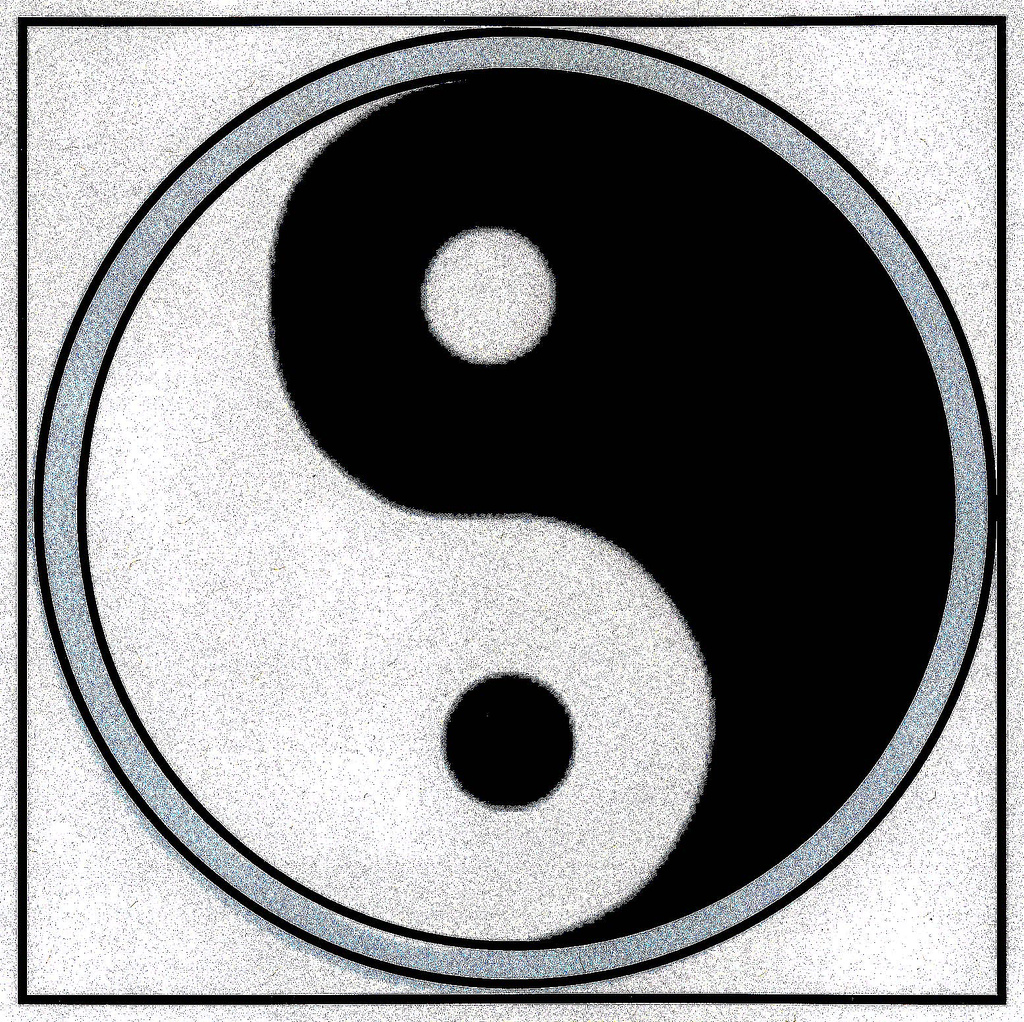
Now here is where the Yin and Yang come in. Good reflecting requires the ability to consider both our light sides and dark sides, our strengths and also our mistakes and problems. It is a balancing act of “inner” and “outer,” tied together in a continuous loop. Joe McCarthy’s excellent posting on practicing and preaching is a great example of this loop. Effective reflection sometimes takes us down into very dark territory and sometimes into joyful and uplifting discoveries. This is why I like the ancient symbol so well. Dark flows into light and light flows into darkness, and each contains its opposite just to make sure we get the point that nothing is ever absolutely pure. Yin and Yang are not about good and bad, but about polarities, such as the revolving passage of the seasons. There can be good and bad winters, but today it is just this season, in its constantly evolving transit to the next. It’s no surprise the symbol itself may have come from ancient astronomical calculations.
What this means is that for us to learn about ourselves, we have to take an attitude that honors all sides of who we are. It is what I would call “whole-heartedness,” which means to me bringing all of who I am to some task, whether that task is writing a posting here, serving a client, or fostering a living partnership with my friend, Jane. I bring my whole heart, not just the good parts or the bad parts. I bring it all — and I’m willing to work with it all. Wholeheartedness brings together surrender, love, passion, and compassion. It is a kind of intelligence that embraces intellect, emotion, spirit — and mystery. If I adopt this attitude in my self-knowledge work as a leader, I will become increasingly aware of my conflicts, my insecurities, my needs, and my talents. And I can start to bring a whole picture of myself into focus. I can begin to carry my life-energy into my challenges in new ways. I can begin to connect more courageously and patiently with others.
There is a particular kind of grace that comes with a whole-hearted approach to self-understanding. There should be a word for it, although I doubt there is one. The ego-less seeing of one’s true value is quite a wonderful thing.
But, if I stand back from whole-heartedness or only focus on a part (if, indeed, I only want to see my good self or my bad self) then I really am not wholehearted and I will try to compensate. I’ll try to hide some part of who I am — probably by projecting it onto someone else. I won’t let in what is yet unknown, and this, of course is the whole trick to self-knowledge, isn’t it, letting in the unknown?
A good reflection may help open just that door.
Whole-Heartedness
 Slowing down, I risk seeing more than I bargained for. But I will take the risk anyway. What is leading but learning to follow an inner revelation into the outer response of the world?
Let the dark matter come forward out of the shadows, the things I’ve avoided; let the light matter come forward; the things I’ve been blind to. Today, I will look them all in the eye and introduce them like old friends.
Whole-heartedness is a gift of the gods, shattering every other mirror.
Who am I to experience this good Self, exactly as I am?

You have a very thought provoking website. I’ve never been in a leadership position with a company, but I can see how meditation and reflection would be important to personal success.
I’ve always felt that people should step back and try to see the “bigger picture” around them in terms of work, politics, religion, etc., since we are the sum of all things that touch us in life, not just our work.
Anyway, I liked your blog and I’m looking forward to reading more in the future.
“…we are the sum of all things that touch us in life…” What a great thought. Put this way, I want to go back in memory and recall all the people and all the experiences that have touched me! Thank you for visiting and commenting, Kathy.
Dan: your posts consistently represent, for me, invitations for whole-hearted engagement … and reflection. Thank you for sharing them!
Your insights artfully tie together notions of “a path with heart” (Jack Kornfield) and “spiritual warriors” (Don Juan via Carlos Casteneda), and beautifully expand themes upon which I’ve only briefly reflected and ruminated, prompting me to review and re-reflect. I hope you won’t mind my preaching what I want to practice by quoting from a passage of Kornfield’s book that springs to mind:
In a spiritual informed life … inevitable difficulties can be the source of our awakening, of deepening wisdom, patience, balance, and compassion … our problems become the very place to discover wisdom and love. …
Very often, what nourishes our spirit most is what brings us face to face with our greatest limitations and difficulties. …
The place where we can most directly open to the mystery of life is in what we don’t do well, in the places of our struggles and vulnerability. These places always require surrender and letting go: When we let ourselves become vulnerable, new things can be born in us. In risking the unknown, we gain a sense of life itself. And most remarkably, that which we have sought is often just here, buried under the problem and the weakness itself.
Kathy: I would argue that everyone is in a leadership position, and that we are always leading — and teaching — by our own example(s). If I may be indulged to mention yet another quote, from Marianne Williamson’s book, “A Return to Love”:
Our deepest fear is not that we are inadequate. Our deepest fear is that we are powerful beyond measure. It is our light, not our darkness that most frightens us. We ask ourselves, Who am I to be brilliant, gorgeous, talented, fabulous? Actually, who are you not to be? You are a child of God. Your playing small does not serve the world. There is nothing enlightened about shrinking so that other people won’t feel insecure around you. We are all meant to shine, as children do. We were born to make manifest the glory of God that is within us. It is not just in some of us; it is in everyone. And as we let our own light shine, we unconsciously give other people permission to do the same. As we are liberated from our own fear, our presence automatically liberates others.
Please note that I do not mean to imply anything about inadequacy, in you or anyone else, but simply re-inforce the notion that we are all leaders.
Namaste.
There is some really nice stuff here. I have heard the quote on “our greatest fear is not that we are inadequate, but powerful beyond measure.” I love it! Why, because I must admit that I have found that to be true, I often find myself restless, fearful, filled with anxiety, that my hopes and dreams are so important that I am not doing what I need to do to be great.
Back to the writing by Kornfield, he pinpoints a different topic which I just began writing on in my blogg, why is it that difficulty brings progress, that difficult is where we obtain wisdom. I agree that difficulty opens up new uncharted waters of growth, but I have found that if these challenges shape us whether we are aware of it or not. And it is in the asking and questioning that the wisdom begins to present itself.
Why though, must we search for joy and peace, yet find wisdom and growth in our struggles. Where lies that midway point where one can courageously struggle forward towards progress, but find enough love in his heart to smile and breath happily on each morning?
Find me at “Discoving the Mystery”