Hear me read this post.
Capability, meaning the skills, intelligence, spirit, and desire — the full mental and emotional potentials to lead. For some of us, this word, capability, is a tough one. It means “equal to the task.” I know a number of people, clients and colleagues, who struggle with interior “voices” that tell them they are not ready to lead and may never be. For these folks, “capability” has come to mean “adequacy,” and is attended by feelings of frustration and self-criticism, sometimes depression. Actually, my sense is that the best leaders, not the worst ones, are closer to these feelings, precisely because they value leadership so much and are not blind to its requirements. There certainly have been times in my own life when I’ve known these feelings, too, and wondered about my own capacities.
I am reminded of the famous words of author, Marianne Williamson, often incorrectly attributed to Nelson Mandela’s inauguration speech.
Our deepest fear is not that we are inadequate. Our deepest fear is that we are powerful beyond measure. It is our light, not our darkness that most frightens us. We ask ourselves, Who am I to be brilliant, gorgeous, talented, fabulous? Actually, who are you not to be? You are a child of God. Your playing small does not serve the world. There is nothing enlightened about shrinking so that other people won’t feel insecure around you. We are all meant to shine, as children do. We were born to make manifest the glory of God that is within us. It is not just in some of us; it is in everyone. And as we let our own light shine, we unconsciously give other people permission to do the same. As we are liberated from our own fear, our presence automatically liberates others.
As powerful as this statement is, it certainly can be in conflict with our actual personal histories and past conditioning, particularly the messages we received early in our lives regarding “stepping up” in more interpersonally exposed places. Stepping up may have been regarded as arrogant or impolite, foolish or useless, or simply reserved for others on the basis of cultural norms.
What can we do, if these feelings persist and stop us from living our dreams? How can we remove the whole mechanism of cultural belief and personal self-deception that keeps us from living our true capabilities? How can any of us realize and actualize ourselves as instruments of conscious, positive, confident change?
To me, the answer to these questions has to do with what a person sees when looking within for his or her own leadership. If I look and see nothing or feel drawn into a dark vortex of uncomfortable feelings, then I know I am at the starting point. If I can see and acknowledge my most positive attributes and values, then perhaps I have begun to move down the path. If I have gone even farther, to examine my own blind-spots, discovering a true gift or two and feel a rising tide of light within, then I know my confidence is beginning to genuinely express itself. And if this light, this “inner wisdom,” this “genius” is a radiance I can no longer contain, if it is music that I no longer play as an instrument of change but instead is what plays me, then surely, this is the way.
The stumbling block around adequacy is the assumption that confidence is about force rather than practice. If I try to force my confidence, all that is awakened are the brooding insecurities that hide within my unconscious Shadow side. I may be able to accomplish some things, but at a certain moment — quite possibly the one in which I need real confidence the most — I will be betrayed by the insecurities I am concealing. However, if I make a practice of simply standing in what I know to be my own insecure spaces, then light can begin to come in and begin to grow — light that can eventually disarm the ego and be the change for which I learn to stand. True confidence is always based on an acknowledgement of the truth about myself and my ultimate insecurities, and this truth in turn is what opens a portal to the greater wisdom that can pour through me. Inadequacy is not “overcome.” It is erased by a greater wisdom, passion, or beauty expressing itself in a human life.
Let me share, with her permission, an example from the work of Jory Des Jardins, an accomplished writer, media consultant and co-founder of BlogHer. In two especially beautiful posts on her weblog, Pause, (here and here), she shares her discoveries of how her writing is an aspect of what flows through her.
Since I was in high school I liked to go on long walks or bike rides, immersing myself in music on my Walkman/iPod. I always came back from these walks renewed. I started to pay attention to the thoughts that generated during these walks and realized that I’d always had conversations going on in my head, but I’d often ignored them. I also noticed that I didn’t “write” these conversations–they wrote themselves. The voices seemed to pre-exist–I never summoned or conjured them intentionally. I asked myself, what if these voices that I’ve ignored have something to say? I learned to still my mind and listen to the conversations play out, like I was listening to music. I also learned to take note of the interesting parts.
One day I challenged myself to write down one of these conversations. The process felt like dictation–like I was writing down someone else’s words, not my own. I pulled the dialogue into a short story and asked my writing group to review it. They thought it was the best thing I’d ever written. It occurred to me, almost painfully, that amidst the years of forced prose I had in old file folders–reams of bad writing, that divine energy, or flow, was tapping on my shoulder, saying, in effect, “Lady, you asked for insight, and you got it! Here it is!” I just never acknowledged it because it was too easy; I didn’t slave over each word or sculpt the writing. It wrote itself.
Jory’s words represent the non-egocentric power of a true gift, the thing that flows through without thinking, without the paralysis of an embarrassed or insecure self-consciousness, without the negative censoring voices that can cut any of us off from the source. The flow is not forced, but also requires a commitment to the practice of staying open; in Jory’s case, to a flow of words that write themselves. The gift just is. If you take the time to savor both of Jory’s posts, they may, as they did for me, remind you of what flow means for you. It is safe to say that her writing is an essential part of how she leads in the world.
 Our leadership is a reflection of the Radiance pouring through us. For some, the process of awakening and allowing this Radiance is easier than for others. You might say, “Well, you are really describing the unfolding of a mythical, psychological or spiritual quest.” And you would be right about that, although this quest is not one I would associate with any particular religion or framing psychology as much as just my personal effort to find metaphors and images for our growth into true human beings. My words and symbols are just my own ways of speaking about something that is essentially divine. Radiance, I believe, comes of itself, and may be halted only by trying to coerce it. And this, I sense, has great implications for the nature of genuinely human leadership. Our job is practice, not pressure.
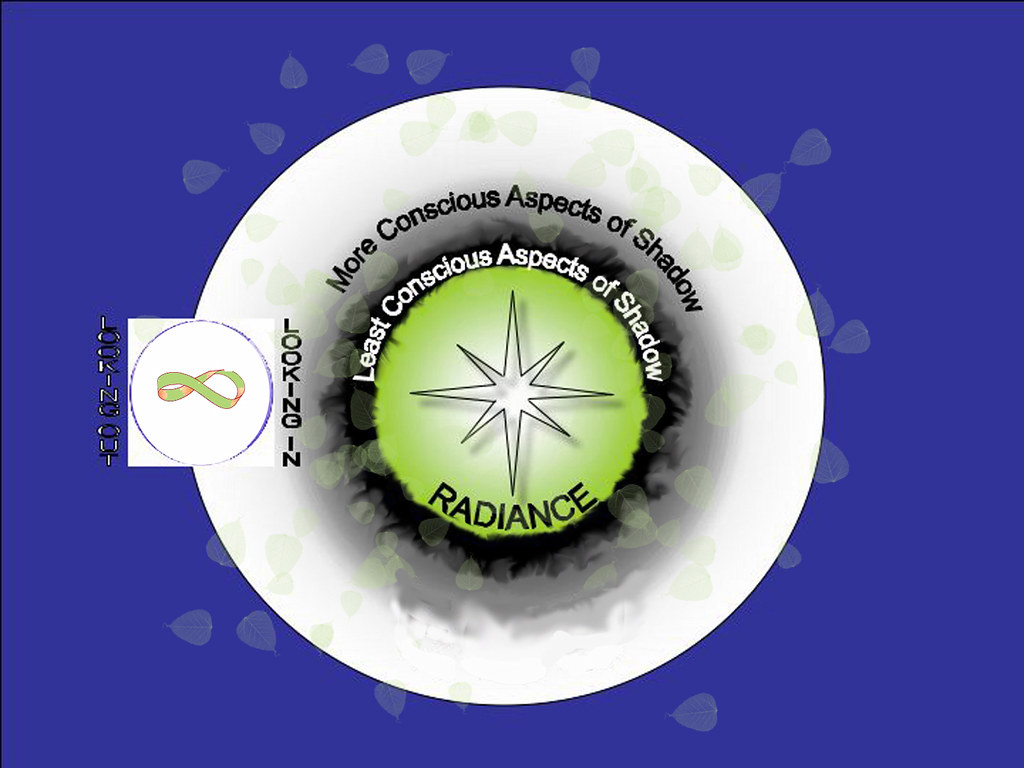
Below you will find three diagrams behind the heading links, three mandalas, intending to describe the course of development in our capabilities to lead. The stages are not necessarily linear and are not all-encompassing. Some aspects of our personalities may be more open in some circumstances than others, so we mostly hold these stages simultaneously in different parts of ourselves. Knowing we are in part imperfect, inconsistent and insecure, we can practice the art of gradually allowing more of these parts to open, allowing more of the Radiance intended for our personal “channel” to flow through us into the world.
When we are defending, the interior world is a dark and vulnerable place. We protect it, and we wear the mask of a fencer who is mostly “on guard” to defend our unknown territory. The darkness leaks out as we continually make sure neither we nor others see what is going on inside. If there are problems, they are caused by what is outside of us, not within.
If, by chance, we become curious about the interior world and just brave enough to begin the journey, we enter the stage of opening. Here we discover that there are more and less conscious aspects of Shadow — our unconcious side. The more conscious aspects sometimes appear as self-critical voices that remind us of our weaknesses and can sometimes overwhelm us. The more we enter, the darker it seems to get but, in truth, something waits for us on the other side of the Shadow’s darkest walls. Eventually light and life begin to appear in new forms. A seed we plant germinates. We discover some aspect of our interior light that, like an angel, contains the message of a destiny or purpose. Like the Roman god, Janus, the god of doorways and windows, we begin to identify with looking both inward and outward.
As more areas within us awaken, as we discover and break old patterns in our conditioning, we find ourselves to be channels for a Radiance that gets brighter the more it is allowed to pass through. While some Shadow energies always remain as mysteries to be gradually unlocked, the Radiance wipes out the distinction between looking out and looking in. What is left is the flow, an infinity that is neither wholly one or nor wholly the other, but both combined.
The trend-line in three diagrams depends on our willingness to enter into the darkness of personal and social unconsciousness in order to learn. The central learning is how to lose an ego-life in favor of a higher Self. How we express this realization in our own lives does not have to be in big ways. As much as we may want to change society or the world at large, the most immediate expressions may be in the smallest daily acts of leading: in compassion, in generosity, in acknowledging mistakes, in connecting with other people, in telling a good story. And then, perhaps, fate will bring us our possibilities and our larger chance to be of service.
So now, what is it that defines our capability to lead? Only this: the practice of allowing our Radiance to express itself in the world. If I have no idea of my own Radiance, then my leadership will at best be a partial thing; at worst, it may do damage. A person locked into defending an unexamined personal darkness, who never turns to find the interior Shadows, can loose incredible destructiveness and violence.
Instead, I must have a sense that there is something much larger than my ego at work and passing through me, even at this moment. And for that to happen, I may have to constantly ask myself, following Williamson’s famous affirmations, “Who am I not to lead?” Because of past conditioning, I may have to consciously learn as much as I can about my critical voices in order to still them. I may have to practice letting go the ego energies that erupt each day like small fires only to burn themselves out. I may need to clear the pipes of all my private negations so that Radiance pours like water outwards to do its healing work in the world.



A lovely piece Dan.
I agree with you that it’s very difficult to overcome feelings of inadequacy; but thankfully we don’t have to.
It seems that whatever we give our attention expands in our awareness, and so it is in giving ourself the space (Jory’s walks and bike rides!) to allow our True Self to grow in our awareness that dissolves the ‘inadequacies of the ego’ ie. not by force but by the feelings of Love growing within us bringing the simple recognition that ego thoughts are totally unfounded — that they are based on a limited and fearful self perception that is simply not true.
Thank you, Nick. You understand completely.
Dan, thanks for the insightful and inspiring post! The Marianne Williamson quote is one of my all-time favorites — thank you for shining, and giving me permission to do the same.
Many other aspects of your post resonate deeply with me, weaving together several threads I’ve been following lately, consciously and unconsciously. I’ll just note three of these threads here.
The stages of radiance you so wonderfully outline are reminiscent of the stages of grief, but I like the enhanced simplicity and positivity that you express here (not to mention the mandalas — I’d love to see them compiled into an animated GIF).
I was also reminded of the Prayer of Saint Francis, especially its reference to where there is darkness, [let me sow] light.
Finally, as so regularly happens with your writing, I got in touch with the poetic dimension of life. In this case, your reference to the “music [that] plays me” reminded me of a Rumi poem, Each Note:
…
God picks up the reed-flute world and blows.
Each note is a need coming through one of us,
a passion, a longing-pain.
Remember the lips
where the wind-breath originated,
and let your note be clear.
Don’t try to end it.
Be your note.
I’ll show you how it’s enough.
Go up on the roof at night
in this city of the soul.
Let everyone climb on their roofs
and sing their notes!
Sing loud!
Readers…
Joe McCarthy sent me a great montage of the diagrams in this post. You can see it here.
(If you couldn’t find the individual diagrams, click on the names of the three “stages” in the post. Sorry this wasn’t clearer.)
Joe
Thanks so much for your insightful comments and links, and thanks again for the cool montage. You are true friend.
Great post, Dan.
I may have experienced some of what you write about. Since last May’s BTE, I have had several occasions where I have had to make my way through some significant and challenging work problems that no matter how strategically I approached them, I could not find an answer or way to face them that made any sense. Essentially I gave up trying to find “the” answer and sent the problem out to the universe (much like the beach ball guy in Jory’s blog) and simply asked for whatever answer there might be. And by some experimenting with this sort of letting go I had built up confidence in the process enough to have faith that the right thing would be provided … if I were alert enough to see the answer. Paying attention and being unattached to any particular kind of answer became a crucial factor too.
I remember dealing with a particularly difficult personnel problem that I could not find a suitable answer for and it did not come until just before I had to address the problems in a face to face meeting … but it did come. I could say that I just made it up, but it came from somewhere and I have the feeling it was not “me” that provided the solution. I was the medium that allowed the solution to manifest in my “real” world. Throughout this situation the feeling that I was not up to the task would often wash over me but I knew I had to deal with it directly and decisively but I never really could solve things by just thinking through the problem and deducing the best, correct answer on my own. I had to let go of it, let things happen, and then respond as best I could from the heart. That is, I wanted to be fair, honest and as direct as I could be in the situation considering the multitude of masters I was serving.
I had thought that the “practice” you speak of was something that you did because it was following some way that had been laid out. That way might be from something I was taught, had experienced, how I perceive the world as working, how I perceive myself as being. However, I am coming to think that what may be more true to reality is that a person make’s the path or the practice by walking (doing) every day, by letting things happen but being in action. The path appears because I am interacting with things and it takes me to interesting sights. It mirrors your blog’s new name: life unfolds from what was there all along and what we have to do is interact with what is there. The trouble is that many times I fear letting go enough to walk on and let life unfold and then be response-able to what is presented. Sometimes I don’t want to deal with what is there; I want it to be something else, something nice. It presents a paradox, at least for me, in that “actionless action” where waiting and watching in the “stillness” for the right action to come (and it can come in a nano-second) works and striving, which is what I am used to and comfortable with, often does not. To get there I have to be open and unattached, not always an easy thing to do. The other part, and this can be uncomfortable too, is to be ok with not being the answer guy, but just being the guy who had the ability to let things happen in a natural way, which seems too simple and not enough hard work.
Dean F.
Dean
“It presents a paradox, at least for me, in that “actionless action” where waiting and watching in the “stillness” for the right action to come (and it can come in a nano-second) works and striving, which is what I am used to and comfortable with, often does not.”
There’s a story that the Buddha once said, “the hardest thing is waiting.” I like the way you hightlight this in your comment, Dean, and contrast it to striving.
Many years ago, on a late night flight back to Seattle — after an especially bad consulting day — I found myself writing a poem called “Trust the Angel.” It was my version, I guess, of the release from striving. The poem became a mantra to me, a private prayer of opening, a source of energy that has carried me through many challenges, as if the sequence of moments in which I have genuinely trusted the angel is the real biography of my life. It helps me to remember (and this is reminiscent of Nick’s comment, above) that what comes through the portal is not just ideas or insights, but the most authentic affirmation possible for the person who is willing to just open and “receive.” Call it light or love or Intuition, in the moment of real receiving, there can be a remarkable sense of wholeness. I can no longer tell: is it me seeing into my True Self or is it my True Self seeing into me?
This is beautifully gifted coaching Dan. I remember reading this when you had first posted it, and getting lost within my own thinking about the abundance of capacity versus the desire and intuitive intention of capability. I love the two words (capacity and capability), and have long thought of a four-fold dimension to capacity (physical, emotional, intellectual and spiritual) as what gets filled up with personal abundance by the driver of our capability.
Then today, it is a wonderful deepening to read (and listen to you read) this again when the value of the month we now celebrate within the Ho‘ohana Community is nÄnÄ i ke kumu, one I think of as self-respect and dignity of spirit. The illumination of Radiance is so self-affirming, as is trusting that we do have it, and simply need to release it.
With much aloha,
Rosa