Here they are:
1. What is one thing I can do to get better feedback about (a particular aspect of) my own performance, my leadership or my relationships with others?
2. What is one thing I can do to show more vulnerabilty and ask for help (in a particular area) where I know I need to grow?
3. What is one thing I can do to contribute to (an aspect of) how we make and execute decisions  as a team?
4. What is one thing I can do (on a specific issue or with a specific person) to operate more collaboratively?
5. What is one thing I can do to put a (specific) hard issue on the table and work on it with others in a constructive way?
6. What is one thing I can to better appreciate and affirm the talents and accomplishments of a (specific) team mate?
You will notice that the trust that is being ignited, first and foremost, is your own. You will notice that the questions all begin with the words, “What is one thing I can do…?” You will notice that the questions ask you to fill in issues or people, not speak in generalities. (You might also notice that these questions happen to align with the six areas rated by a free survey I created on developing team trust.)
Wouldn’t it be incredible if everyone in a team you are part of regularly asked these questions of themselves — and it was okay for team members to talk openly about their answers? Â Think of the powerhouse group that could create: Â A team where people regularly ask for feedback, acknowledge the areas they need to grow, asking for and offering help to one another. A team in which people are constantly are at work improving their decision-making processes, making them increasingly transparent and accountable. A team where people are constantly in the process of learning to collaborate with one another while putting hard issues on the table and working them through. A team where people genuinely appreciate and support one another.
A team, as a result, with an amazing level of trust, and a similarly amazing synergy in performance and innovation.
If you and your group don’t do enough of this kind of questioning, do not despair. Most groups do not. The real or underlying question is whether we actually understand the true power of the questions we can ask ourselves and our teams.
It turns out, following the dynamics of how our brains actually work, asking such questions opens the way to building new neuron pathways. Regularly asking and answering such questions liberates the possibilities for new learning — as individuals and as workplace communities. And new learning actually…wait for it…makes us smarter.

Palouse
It can also, I would say — if we ask the right questions — deepen us as human beings, as well.
But there are some critical pieces to this questioning work. The questions need to focus on specific actions, they needs to be positive, and they need to be about you, not so much others. Why is that? Well, specificity and the actual doing are the catalysts to changes in the brain, not, as it turns out, general discussions or commentary about what others should do. That shouldn’t be any surprise. Questions about what we should do, are okay, too, but they are often less the place to begin than the more personal self-questions. The self-questions invite disclosure in a more concrete way.
There are reasons why we keep things so general as to be indirect and focused on others rather than ourselves. Sometimes, we say it is to protect others. Sometimes we also use it to protect ourselves from taking too many risks at work. But mainly, it only protects the gated community called “the status quo.” I don’t mean the status quo, organizationally, out there, but the one in here; the one that has to do with how you or I define who we are and how we will live. Asking ourselves, answering ourselves and one another, and acting on our discovered answers radically challenges that status quo. People often tell me that for their team (or their whole organization) to improve, it is up to others — someone else — to change and grow.
Do you see what I mean, how that’s pretty much a vote for the status quo?
What I’ve seen within teams where even a few members begin with themselves is that they can build toward major energy for collective change. One person’s willingness to become vulnerable can trigger another’s felt need, as well. In the end, those who seem most recalcitrant or invested in their own private Idaho can gradually come forward. Sometimes these folks reveal extraordinary things in the process — why, for example, they’ve hesitated; what’s happened to them in the past that now causes them to be careful; competitive or mistrustful conditioning from other organizational environments; even feelings, perhaps, that they may not deserve to be part of such a powerful and open team environment. My point is that the whole resistance thing over time can begin to melt. Patience, persistence and offering a sense of inclusion to every person, however much that individual can disclose at the start, is key.
Here’s a diagram produced for a team I worked with a long time ago. They did some work in line with the exercises in this paper to look at the light and dark sides of their team participation — essentially their gifts and shadows that were part of their mutual relationships. The diagram shows how negative, stressed, or defensive behavior on the shadow side could start with anyone but how it became mutually triggering. Soon enough everyone would be involved.
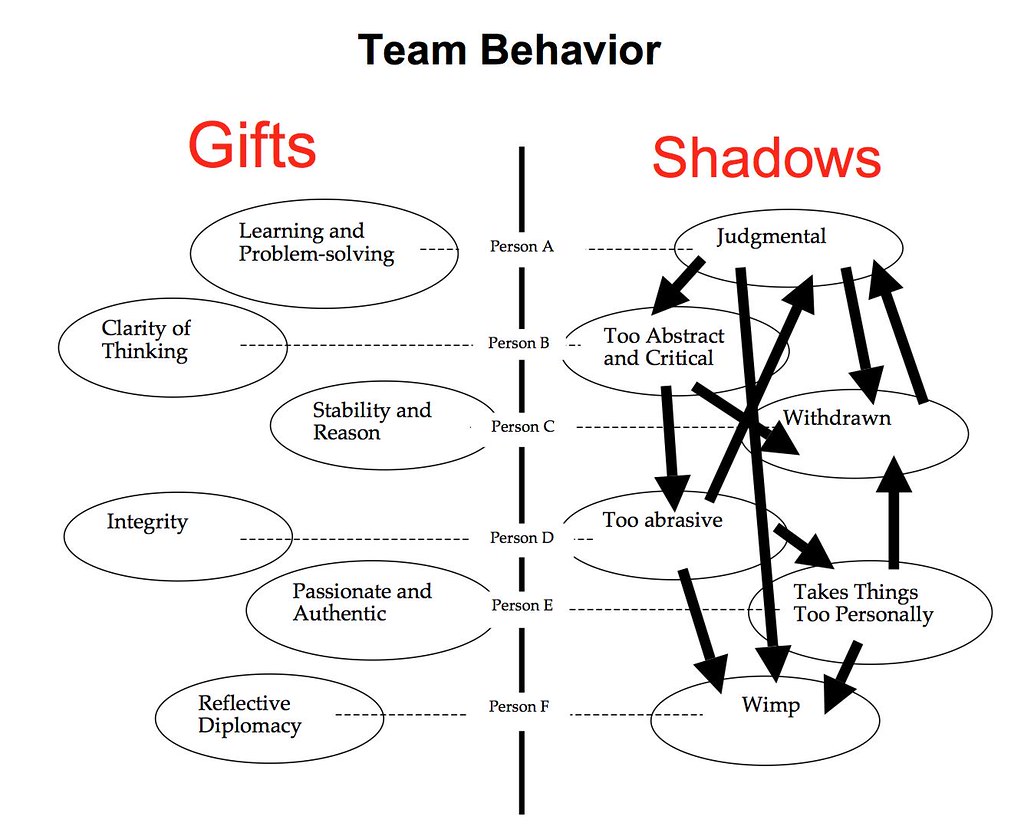
But if the downside group behavior (in this case, mainly blocked decisions) is the result of mutual triggering, so too is more positive behavior — it just typically takes a little longer and needs to be more consciously applied. And the good news is, it can come with the questions that I’ve listed here when individuals in a team intentionally take on the work of group trust-building. A question, asked of yourself, is like a candle. Lighting yours encourages others.
And pretty soon, if you stick with it, if you are truly willing to change your own status quo, you can find yourself in a room filled with light.

Dan: I really like this questioning approach, especially with the emphasis on taking our own inventories rather than taking others’ inventories. I also believe in the cascading or contagion effects of being open and vulnerable, at least in the right context or environment (seeing someone getting beaten up — physically or verbally — after revealing shadows is not likely to encourage further vulnerability among those witnessing the abuse).
At the risk of veering slightly off-topic, I was reminded of some fascinating technology I discovered and wrote about in the context of lock and key parties and object-centered sociality a few years ago. Participants in OneKeyAway singles events filled out a 64-question survey before the event, and the answers were compiled into a code that was downloaded into individual MatchLinC keyfob-like devices which were handed out at the start of the event. During the event, men and women would line up and “zap” each other, and the MatchLinC devices would glow red, amber or green depending on the inferred level of “compatibility”.
I mention this in the current context because I think the real power of this system was not the technology but the priming effect of the questions, which went into levels of depth not commonly encountered during a light-hearted singles event. Areas covered by the survey included:
* Relationship expectations
* Emotional responsiveness
* Personal behaviors & habits
* What you do in your spare time
* Sexual orientation and preferences
* Topics on religion, substance usage and more
I never participated in an event, and it appears that OneKeyAway is no longer in business, but I suspect that any success at the events was more due to the surveys than the technology. I imagine the invitation to participants to simply think about and respond to deep questions set the stage for deeper and more meaningful conversations to evolve much more quickly than might have been the case otherwise.
I don’t want to draw too much of an analogy between dating and the workplace, but both contexts involve relationships, and I think that priming with the right types of questions — within a sufficiently safe container — can lead to deeper relationships.
Exactly. What’s also exciting to me is the notion, from what I’m learning about the brain, is that we can actively create new neural pathways that reinforce and further open us to positive experience. It’s not just the question, but acting — even in a small way — on the answer that can change things. In your example, Joe, people actively used and were encouraged to interact based on their survey replies. Just so, the process channelled the desired experience.
always, insightful work. thanks dan!
Thank you, Kellee…and there is so much more. Even since I wrote this post, I am learning and may either revise this one or write another with even better questions!
Dan — This is a helpful and thought-provoking article. The questions and the ideas around them are excellent, and I agree that the focus on what ‘I’ can do is likely to be very helpful in encouraging some ‘hard’ issues to be shared in a way that allows people to acknowledge their part in them and shift their own status quo. I also like the diagram of mutually triggering gifts and shadows.
One question I wonder about is whether every team would use these questions to generate light, or whether some would also ignite flames — of conflict and anger.
I agree with the previous commenter on the potentially contagious nature of a willingness to show vulnerability, and similarly I also believe that exploitation and scapegoating are contagious too. At least some teams in some contexts and environments may find that their shadows come out to play with these questions destructively, as much as they would in other high-risk situations.
You are perhaps allowing for this in the idea that this work “takes a little longer and needs to be more consciously applied.” However, I’m not sure we have much control over the interplay of gifts and shadows. I suppose I take the view that outcomes of conversations are inherently unpredictable and uncontrollable (and even often unknowable to any one individual), no matter how good the questions that ignite them.
Of course, if conflict is ignited, I think its flames may — in the long run — be as enlightening as the candlelight you portray. I also think it’s possible, if less common, for trust to arise from conflict too.
Thanks again for your thoughtful sparks!
Andrew
First, thanks so much for writing. You obviously are someone with experience facilitating team development work. If you are like me, you have been asked to help with a variety of teams, including those where there is more dark than light. That means in real terms the presence of volatile negative feelings and perceptions, including anger, distrust, bitterness, blame, cynicism and insensitivity. Believe me, I’ve been asked to help in such circumstances and it is no picnic. You are absolutely right that on the way to light there can be expressions that are uncomfortable — sometimes withering!
I continue to believe that the risk to enter those situations, as a facilitator, but more so as a member or a leader of a team, can be entirely worth the trouble of the passage. In fact, I would say that the fear that a team will “implode” is precisely one of the motivations to begin the process. And so far as I know there are no guarantees or perfectly safe ways to proceed in such circumstances. To the contrary, the willingness to enter with informed courage is essential.
I have seen some remarkable things when that courage has come forward, and I bet you have, too, when individuals express their innate maturity, their willingness to be vulnerable, to listen to hard news and act on it for the benefit of the group as a whole. I believe we are innately capable of that courage — and as you mention, conflict is sometimes essential to the process of renewal, particularly if the team is at a ‑1 or ‑2 level of trust according to the framework of the Team Trust Survey.
What makes the process worth the “flames” is something of remarkable power, but also something that is rather fragile — the enormous beauty of the human spirit, and its nobility. That may sound idiotically idealistic, but it is my truth. Everyone has been hurt in their way; everyone has their regrets and angers. Can we create a space where hope and forgiveness are the norm? Can something that is unhealthy actively choose to become healthier? Can understanding replace blame? Those are the questions, in addition the ones I share in this blog, that I might well ask a person or a team. Those for whom the answer is yes stay, learn, and flourish. Those who cannot usually decide that their path lies elsewhere. Those are hard, hard choices, but they are the essential ones.
By asking and answering the questions I’ve shared (and I may add another post to clarify and amplify them), what we have is a starting point — not of blame or criticism but of self-knowledge and self-action. That, in fact, is the most threatening entry point of all, and so, paradoxically, the safest. It cannot be forced on anyone. All we can do as facilitators, team members, and leaders is choose it for ourselves, inviting it from others, and welcoming those who are ready to come.
Dan:
You are such a thoughtful and helpful writer. Thanks for all your contributions to my thinking in 2010.
David
Thank you, David, but really your own contribution by building a wonderful community devoted to engagement is so powerful it is you that deserves the gratitude!
SIX MORE QUESTIONS
In response to a blog dialogue with the brilliant Dr. Ellen Weber, here is an evolving list of the above questions. The intent is to match deep content with a rich invitation to curiosity, as this uses the the brain’s own chemical responses and capacity to develop new neuron pathways. I’m not sure I’ve got this all yet — in fact, I’m sure I’ve not, and would surely appreciate your help and feedback about how best to frame the questions.
1. If I felt truly safe to share my feedback with others and to ask for it about myself openly, how might that unleash my capabilities?
2. What deep, personal wisdom might I find on the other side of taking the risk to fully share my insecurities, mistakes, and the deepest questions I hold about myself?
3. What do I most want to do to add power to the decisions we make as a team?
4. What is the one most important thing I can do to create a radical turning point in team collaboration, turning conflicts into stunning synergies?
5. What personal transformation on my part will help dissolve hesitation, unspoken barriers, “undiscussable†issues and subtle mistrust?
6. How do I best love others in my team for being exactly themselves?