Truth and trust bear an important relationship to one another. In fact, it could be said that they only operate together effectively when they are partners in the creation or redemption of human relationships. In that regard they serve within a self-reinforcing cycle. We can’t live well without either’s contribution.
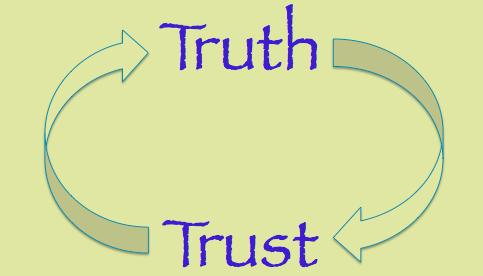
Too often in my work with clients, I see people come down on one or the other side of the equation. Imagine two individuals, one of whom says to the other, “I’d like to trust you, but how can I unless you tell me the truth.” And the other who says, “I’d tell you the truth but how can I if I don’t really trust you.” Of course, these two (and we) may not use those exact words, but their (and our) words do communicate that exact message. It is so easy to form a stasis and a block, a state of half-trust, half-truth that is extremely difficult to influence. And then we try to live with it. But, of course, it is not satisfying. Below the surface there is unhappiness; anger, disappointment, frustration and pain.
How can we get past this dilemma? I could tell more of the truth in order for you to trust, but that would require a risk. — Or — I could trust you in the hope it would make it easier for you to tell the truth in return. But that requires a risk, too. And we’d both have to be committed to something higher, something that would draw us to connect with one another, find our partnership, synergy, and common ground — in the face of that pain.
Wikileaks is a classic example of trying to force the issue. If the truth is on the table, the assumption is that people will be forced to look at a different way of doing business. No secrets leading to a better world. However, if transparency is demanded through involuntary exposure rather than by invitation, the result in my experience most often just creates (or better said) continues a raging war of the spirit. Truth alone can be a killing force, and can lead to waves of retaliation and revenge. To be successful, a meaningful and lasting positive influence, truth must be paired with trust, and that is the challenge of human beings, to find more and better ways to do this. Oh yes, and of course, trust without truth is an oxymoron, too often a compact among thieves. We need to have both.

I have to tell you that I admire what Julian Assange is doing and trying to do. He is a revolutionary and a heroic figure. I happened to watch this video interview of him from TED. In it, in response to a question about his guiding values, he says, “Capable, generous men nurture victims, not create them.” It’s a powerful and honest statement, and he is clear about his own challenges with the nurturing part of that equation, acknowledging his tendency to be “combative.” But, of course, you will also hear how his words divide the world among perpetrators, victims, and rescuers and if you start there, with the world divided in that way, then the actions, limits and drama of Wikileaks all naturally follow on their world-wide stage. I am admiring, and I also believe that the approach is only half of what’s needed; both vital and insufficient.
Whether it’s a nation state, an organization, a team, or only you and me, what it comes down to is this challenge: to put it together. Truth and trust. Trust and truth. If you want to know what this is like, just ask yourself, “What could we be if we expressed our truth with deep care for those who must hear it,” and also, “What if we trusted others enough to actively invite their truths, even if it was hard, painful, and embarrassing for us to hear?”
Perhaps you will find this all naive.
Nevertheless, I’m just saying.

Hi Dan, interestingly a balance of truth and trust is needed in our world.
A recent survey in the American Business Journal points out that people think there is more corruption in business and government.
You weigh Trust and Truth on the scales, Dan, and show examples of how the pair, Truth and Trust, work well together, in synchrony. Thought provoking.
Robyn, thank you for that very interesting link. Obviously, events of the last few years, the big disclosures about companies and scandals in government now drive a certain faithlessness and, unfortunately, a kind of fatalism about the folly of trusting those with power — power of any kind, formal or informal. However, it is not just the fact of the scandals that has broken trust, it is also the way those situations have been handled through “PR” and legal defenses and blanket denials and justifications so that what’s modeled is not just the mistakes but the mistaken ways of dealing with mistakes. These famous means might protect a few people, but they damage the soul of society.
It is no wonder that there is so much energy around Wikileaks. It is people striking back from the depth of their anger, sense of betrayal and sadness about where we are. Your own recent post on reflection seems to me to highlight one of the most important antidotes to fatalistic reaction, showing a way to reduce harm to the soul of the individual, even if the broader social context is a mess. Reflection can, I believe, enable us to choose to a constructive path, one that is full of both truth and trust, one where we actively choose to build and connect rather than strike out at others or strike back at them. That’s where my hope is, anyway, and hope right now appears to be the name of the game.
Best to you.