My father died last Saturday at the age of 96. He had been coping with a series of small strokes that affected his hand movements, hearing, and speaking. He had been a master carpenter most of his life, so his senses and eye/hand coordination were his most fundamental tools. The losses had added up a little too quickly. He communicated frustration and depression. And so he did the most logical thing to cope anyone could do: he went to sleep. He stopped eating; he spiraled down; he started receiving morphine and a few days ago he simply didn’t wake up anymore. I saw him a few hours before he died and it was so clear his spirit had already departed a lingering body.
What homage can a son pay? Perhaps only to tell the story.
My father, Kurt Karl Oestreich, was a strong man. He had to be. He grew up between the World Wars in Germany. In 1937, to save his family from harm by the Nazi Storm Troopers that were harassing his village, he escaped Germany to become one of the thousands of refugees on the road. The Storm Troopers rode into town spraying gunfire. They tortured leaders of opposition parties (which included my father) and their families. Everyone was watched. Over the next three years, after crossing the border, he really only had himself to depend on. He knew hunger and fear and learned to keep his wits about him as he traveled from country to country. He accepted help from good people along the way; saw others abandon their principles and sometimes abandon their lives.
Eventually he was able to emigrate to the United States. But here he also had to defend himself against those who thought he might be a communist or a fascist. He learned the language, and did so without formal training. He became a citizen and enlisted in the military, where he was given the choice to go back to Germany as a translator or go the front lines in the Philippines. He chose the latter. He was soon stationed at Fort Lewis in Washington State and through mutual friends met my mother. He went off to war without marrying her in case something happened to him. He was lucky and they spent their honeymoon at a lodge on Vancouver Island, a place he could fish, his most important hobby.

They were both a little old for marrying in those days, 34. They didn’t have a lot of money. They bought an aging farmhouse on a hill and twelve acres, half in pasture and orchard, half in woods. The farmhouse had only one piece of indoor plumbing, a single cold-water tap that ran from a storage tank in the forest behind the house. They fixed the place up, and they had gardens and animals — ducks, rabbits, and sheep. They had kids, my older brother and me. My dad rebuilt the house, put in the plumbing, built the garage, reshingled the whole thing from scaffolds he built himself. After what my dad had been through, I’m guessing this was pretty close to heaven. It was a dream — of stability, self-sufficiency, and a family that lived without fear.

My father had the kind of intelligence that is forged, not inherited or particularly nurtured. He was practical because he had to be. He was a perfectionist because of the price of mistakes in his world. As a result, he also sympathized with the underdog, whoever that underdog might be. And as a consequence, my brother and I learned empathy for those without money or power, for those who had been tortured or discriminated against for things they couldn’t help, like the color of one’s skin. He hated guns and violence. On the farm, he might take out his .22 caliber rifle to shoot at crows stealing cherries or the feral cats that stole the neighbor’s chickens. One night, hearing strange sounds outside our house, I remember he left it sitting next to the door. But weapons in general and wars on any scale, fighting — they were all anathema. He had known the stench of dead bodies, though he never talked of it, never told boastful stories over a beer. No, what my father was was the classic immigrant who worked his behind off every single day so that his children could have something better than he’d had, so that his wife didn’t worry. How many nights did he come home from his work only to go out in the darkness to care for the animals, get wood for the stove? How many weekends were given to shoring up the foundation of the house with new cedar posts or haying the fields in preparation for the winter? There was one value that was more important to him than all the others, easy to name: duty.
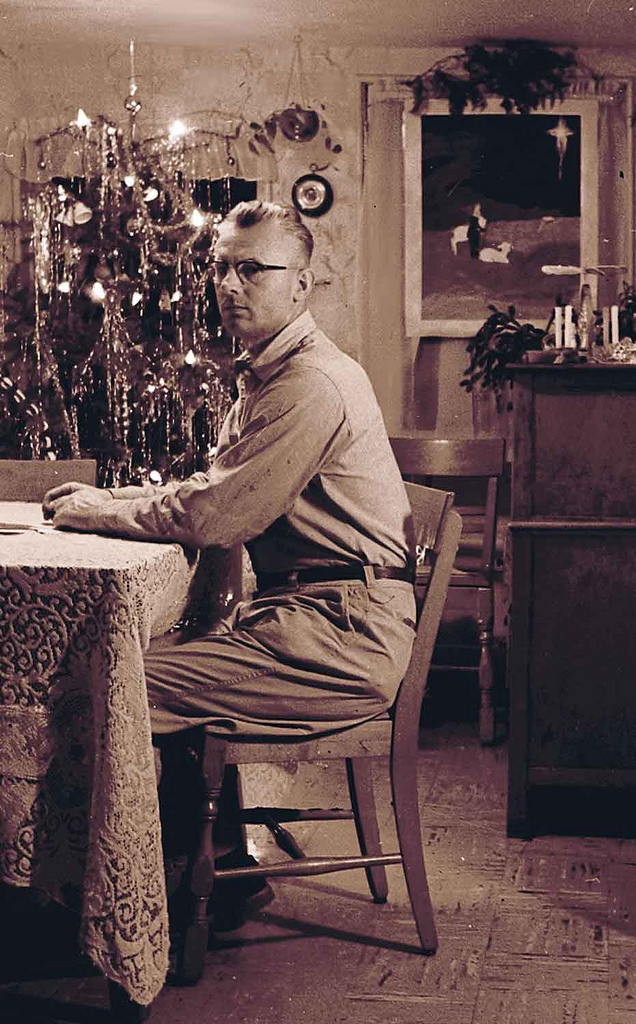 He was not, for as sensitive a child as I was, the easiest person for me to grow up with as a father. He could be cool and distant and frankly a little scary. I identified and connected with my mother (who survives him, by the way, also 96). He saw me as that younger son, “Danny-el Karl” he would say, who “always had his nose in a book.” My brother, the incipient engineer, was more comprehensible. My father didn’t seem to enjoy the conversations about relationships and psychology that were natural to my mother and me. Chances were, as those conversations happened at the kitchen table he was on the couch in the living room reading and napping beneath his beloved newspaper. There were years when the truth was that I was angry with him because I felt so misunderstood and distant. And yet…and yet…he was also the man who paid the bill when I went to the fancy Ivy League college. He was the man who told me to pursue my talents. “These are fantastic ideas,” he said to me one day when I was thirty or so. “You must do something with them.” He was the man who whispered, “You can do more than you think you can.” His perfectionism, over the years, drove me crazy and demanded that I use my talents, make a “contribution to the world,” his definition of manhood. When I wrote my first book his only comment was to point out a misprinted word on page 37. No praise. No recognition. It brought back all the horrendous memories of those nights we brought home our report cards. “Why is this subject an A-? Why not an A?” An interrogation. Although he had only achieved an 8th grade school education, there was no question that every grade he’d ever received in school was an A — oh, forgive me, not just an an A, an A+.
And yet, and yet. There are so many fine memories — him digging in his garden after he had retired, finding the hidden potatoes. Fishing on the ocean or in a stream or lake. My father knew how to sit in silence for hours, waiting, knowing the fish were there. He had never brooked silliness or tangled lines from bored sons. Fishing was serious business. We did our best to wait for the pole to tip, learning to set the hook just so. The dark waters of the lake could last all day, all night if necessary for him. He could be there, watching the tip of the rod the same way I now find myself waiting for understanding of what is beneath the surface in the organizations I work with. My father would have said his downfall was his impatience, his lack of “temper.” But he was, of course, a man who had been tempered more than most. I find myself aspiring to the same.

I’m the kid in the back tossing his hay
Of the many gifts he gave me I want to mention one of the most valuable. When I was eleven, he gave me my first camera. I learned to take black and whites by his hand, understand f‑stops, shutter speed, and focusing, things that matter but are easily lost to automation. By then, he had personally progressed to the saturated beauty of Kodachrome, a slide film popular many years ago. Kodachrome made the colors of any life rich. The reds were glorious, incomparable. They had passion written all over them. My brother and I lay on the floor of our living room, our mom barely in the chair having just finished washing the dishes, as he carefully inserted, one by one, the slides into his projector. A vacation, perhaps, or Christmas. There was always a critique, some of it funny — what captions could we come up with? — and some of it a disappointment in exposure or composition. I learned something there of my father’s true soul.
It would be easy to dismiss this carpenter. He kept a low profile. His humor was in puns, not ribald jokes. His beauty was in the formal wood carvings of flowers he did by hand with his knives and his lathe turnings of vases and plates done in the basement. He could be good at a community meeting where you needed the voice of reason spoken in a tactful and unassuming way. He didn’t want to stand out. He worked for 30 years for one company and then he retired, having survived it all, the economic ups and downs, the years of rising at 5:15 AM, the mountains of his favorite breakfast, Raisin Bran. In his heart, he accepted life as a contest between good and evil and he knew exactly what it was that the good looked like. It didn’t make waves. It was quietly courageous. It was an example. It fought for the underdog. It was smart. It survived.

He was a gracious, hard, imperfect, demanding and sweet man who knew how to adhere to rules of faith and duty that are all but forgotten. I have no longing for that older world. His life was born from things we have little understanding of today, but should never forget.
I wish your spirit well, Dad.
You earned your keep, my father. And now I hope to do the same.

Dan: I’m grateful for the opportunity to learn more about your father. I, too, wish his spirit well. I’m struck by a number of things you’ve shared in this post, but will restrict myself to mentioning three.
“He had never brooked silliness or tangled lines from bored sons. Fishing was serious business.” As a man whose father was very serious, and a father now who finds himself often more serious than is necessary (or, even, worthwhile) — with his children and others — these lines helped me reflect on my level(s) of gravity and lightness.
My father was also a perfectionist. The mantra I most remember from him was “If you’re going to do a job, do it right, or don’t do it at all.” Unfortunately, as time wore on, the “don’t do it all” option was selected more often than the “do it right” (although I think this selection was more unconscious than conscious).
Finally (and I’m struggling to keep my comments brief), I increasingly find myself unconsciously passing values and perspectives on to my children. Among these are a focus on getting the best grades, representing, in part, approbation from “others” — the A+ vs. A (or A-) you mention. I have entered a new chapter in my ongoing struggle between acceptance and striving — as it applies to my children — and am grateful for another dimension of input to help me work through this perpetual challenge.
Thanks for sharing your thoughts and feelings during this momentous period. I wish you and the rest of your family all the best as you make your peace(s) with the transition(s).
Joe.
Thank you, Joe. Of course all this makes me think of what kind of parent I am, too. Perhaps it is always going to be a mixed review — we must live with that. With our children, as with our parents, it’s pure learning, every day.
Dan — Sorry for your loss. You have written a beautiful tribute to your father. I wish his spirit well, too, and somehow feel that it will be carried on into the future quite well.
Dean
Dear Dan, I too am so sorry for your loss. What a wonderful, elegant and power full tribute to your father’s life! I remember you showing me the pictures of your Dad’s farmhouse and you and your brother only a few weeks ago? As we were looking at some of your pictures in your apartment you also shared that your father taught you to how to have an eye for taking pictures when you were growing up. Now in this tribute, you are sharing those pictures along with a heartwarming picture of your elderly father.
Dan, sharing his story is touching and would welcome even more moments you recall where your father has impacted and touched your life. Your tribute helps me to remind me of my own father’s grace as well. Best wishes on this journey in honoring the lives of loved ones we have lost along the way, Clayton
Dan, lots of loving beams to you and your family. Thanks for taking the time to write such a beautiful post about your father.
What a wonderful post Dan — thanks.
Dan, I’m sorry for your loss. It seems as though your father was a great man. Thanks for bringing this post to us.