By negative assumptions, I mean beliefs that you or I might hold about others that label their character or motives in pejorative ways. Seeing another person as weak, for example, or fundamentally selfish are examples of negative assumptions.
Such conclusions have a lot more power than we might expect. For one thing, negative assumptions about others can combine in a reciprocal way to form cycles of mistrust. These cycles embed tensions and distances among people into relationships in predictable and all too often devastating ways. Left unchecked, they erode and fracture our connections with one another at their core.
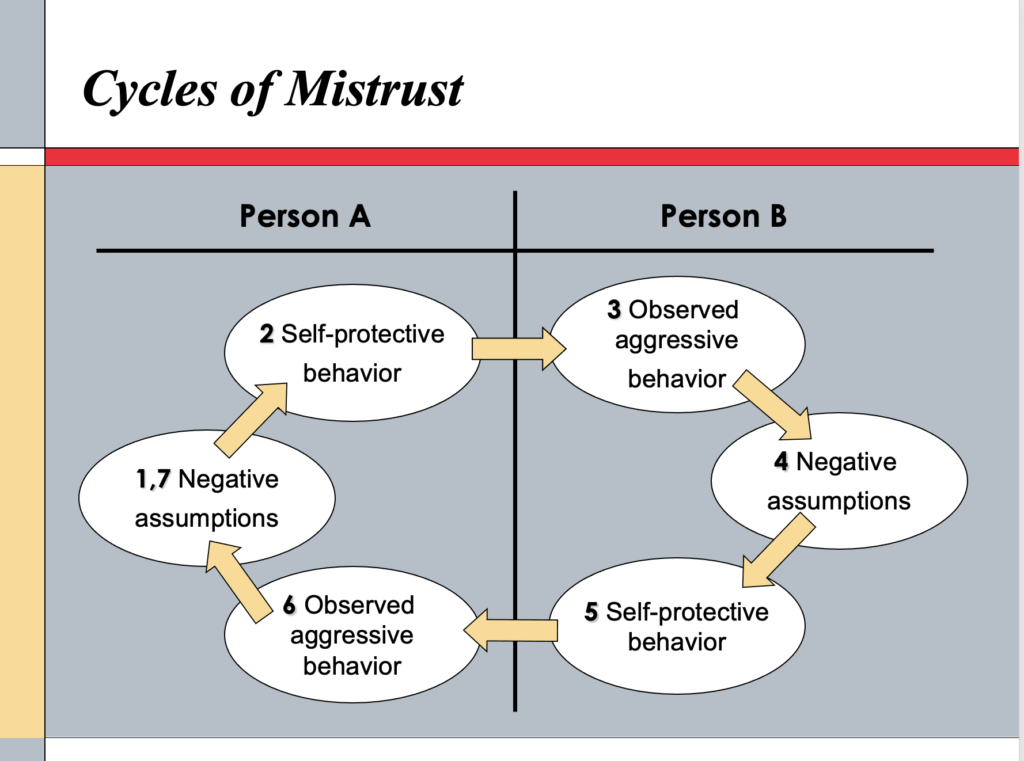
Below is a diagram based on content from Driving Fear Out of the Workplace, my book with Kathleen Ryan from the 1990’s, where we described cycles of mistrust for the first time:
Here is a fictional example of how a cycle of mistrust plays out:
Person A (at Point 1) has heard and believes Person B to be “inflexible and stubborn.” This unconsciously drives A to engage in self-protective behavior (at Point 2), such as taking a harder line when making requests to B. B does not interpret this harder line as self-protective, however (at Point 3). Instead, B sees this as aggressive behavior, leading B to make negative assumptions about A; for instance, in this fictional case B sees A (at Point 4) as “pressuring and aggressive.” As a result, B unconsciously engages in self-protective behavior by becoming (at point 5) increasingly avoidant physically but also terse and indirect in communications. Person A doesn’t see these behaviors as self-protective, however, interpreting the behavior as a form of frustrating passive aggression (at point 6). This reinforces A’s conclusion that B is “inflexible and stubborn.”
And on it goes, around and around. The negative assumptions, “inflexible and stubborn” and “pressuring and aggressive” tend not to change though the circumstances that seem to confirm these conclusions vary from situation to situation. It gets worse as A and B talk to their friends and colleagues who may go along with their perceptions, so that behind what looks like a conflict between the two is also a conflict of the micro-communities around them.
The degree of mistrust between A and B depends on the stakes involved and past incidents that seem to prove true their negative theories about one another via confirmation bias. Each person believes they are operating in a way that is appropriate to circumstances and cannot see that they are not victims but have made a choice to believe a negative “fact” about the other person’s actions and motives. The negative assumptions end up treated as unquestioned “truths” but most often are actually just fear-based reductions of the complexity of their relationship. These reductions can be viewed as projections onto one another and can serve as highly effective triggers of perceived personal slights. If the mistrust is low-grade and minor the combatants may bicker their way into silence and differences re-argued year after year, like relatives around a Thanksgiving turkey. As mistrust goes up, however, and each side continues to reduce the other person to a caricature to be managed, accusations erupt and a state of warfare soon exists. Retaliation (aka “standing up for oneself”) becomes necessary so the other side knows that your side “won’t take any more shit.”
Since open warfare is often unacceptable in work environments, direct hostility is suppressed but the feelings and attitudes remain only slightly beneath the surface, leaking and spreading out across that workplace. Small events trigger and reinforce an ongoing state of tension and stand-off. Passively polite behavior may conceal the fire but doesn’t hide the smoke. If racial or gender or other discriminatory stereotypes play into the negative assumptions, the cycle of mistrust is likely to provoke terrible hurt. No matter whether the level of mistrust is small or great, the combatants usually talk about their annoyances, hurts or hatreds with others in the background but avoid sitting down with each other to discuss their relationship and the sources of their pain. So things go on at some stable point of mistrust. All of this reflects the ingestion of one of the most powerful poisons known to humankind. The more you drink it, the more you may feel you can’t escape it, and the more it begins to define who you are.
You can see how the model might apply not only to conflict among individuals, but conflicts generally: between teams, departments, organizations, communities, political parties, countries, marriages.
The cycle is one of the reasons overcoming conflict can be so difficult. To break it requires surfacing to ourselves and then challenging the beliefs that seem to explain so much, ones we take for granted and depend upon for our own sense of autonomy from our opponent. If they have penetrated deeply enough they may indeed have become a part of our sense of self. After all, they are the things we’ve used to justify our hostility — so letting them go is going to be tough. If we are sincere, however, we will own that our picture might not be complete, might in fact be seriously flawed. Without those beliefs, we can feel naive, vulnerable, defenseless and wrong, a sitting duck and a fool; with them, we are street-smart, self-sufficient, confident and right; commanding respect, a full-fledged member of the gang. I’ve taught many classes on conflict and negative beliefs and in every one of them somebody asks the question, often provoking nervous laughter, “But what if the negative assumptions are true?”
They are potentially always there as temptations. Falling for them easily leads to an addiction to a self bolstered through finding fault with others and explaining away other human beings in terms of their self-interests. I become strong because I see you for exactly who you are and it’s something smaller than I am. Except that this very belief is what makes me small. I can pretend I won’t come down to your level while digging my own deeper hole right beside you.
It seems to me that are some people who do prefer a world in which their negative assumptions seem to drive a part of their identity. There are those in positions of influence or authority who appear to rely on it. But to me that defines anti-leadership and a kind of permanent block to growth. Effective leaders, by comparison, are willing to work with the full complexity of people and the struggles of their own spirits to fully know and be themselves. What such leaders prefer is working to break the cycles of mistrust through positive or at least neutral beliefs, an open, flexible mind and a willingness to revamp judgments rather than letting negative assumptions brick up the walls around an perceived reality.
The most effective leaders also know that they may be faced with negative beliefs held by others about them. They are not surprised by this. They are not undone. They take in the feedback without getting stuck. They don’t cave to the cycle, whatever those beliefs may be. They bring a deeper code, one that focuses on the good things we can do and be as individuals and the good things we can do and be as partners who believe in one another.