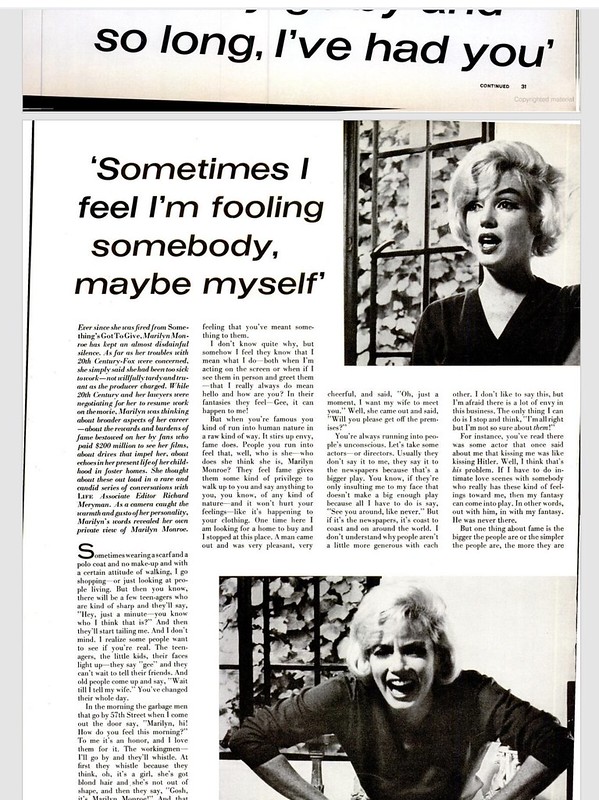
In Marilyn Monroe’s last interview, titled “My Own Private View of Myself,” she explains what fame has meant to her. Conducted only a month or so before she died, her words are resonant with both strength and melancholy, offering a glimpse into her inner world.
“…when you’re famous you kind of run into human nature in a raw kind of way. It stirs up envy, fame does. [Others] feel fame gives them some kind of privilege to walk up to you and say anything to you, you know, of any kind of nature–and it won’t hurt your feelings–like it’s happening to your clothing.”
“You’re always running into people’s unconscious.”
“Sometimes it makes you a little bit sad because you’d like to meet somebody kind of on face value. It’s nice to be included in people’s fantasies but you also like to be accepted for your own sake.”
“I don’t look at myself as a commodity, but I’m sure a lot of people have.”
“…at the studio they had said, ‘Remember you’re not a star.’ Yet there it is [my name] up in lights”
“That’s the trouble, a sex symbol becomes a thing. I just hate to be a thing.”
The fascinating part is her attempt to separate how people see her from how she sees herself and how she would like others to see her — evidently as a way to counter projections onto her. Robert Bly expressly commented about the effects of those projections:
“Thousands, even millions of American men projected their internal feminine onto Marilyn Monroe. If a million men do that, and leave it there, it’s likely she will die. She died.…No single human being can carry so many projections–that is, so much unconsciousness–and survive.”
So she was right to be concerned about “running into people’s unconscious.” You and I might not worry about that so much and yet there is also some work to do around our own private views of ourselves and being able to hear exactly what our inner life is about. Particularly for people in leadership roles who do frequently receive others’ projections, it’s essential there be as much understanding as possible of how our inner sense of self influences our behaviors and relationships, lest we, too, begin to feel we are victims of other peoples’ unconsciousness.
To begin with you can ask “What is my own private view of myself?” Your responses ought to call out, as with the interview of Marilyn Monroe, how your view of who you are is different than how you believe others see you and how you’d like to be seen. This can tell you a lot about your inner life and issues that might be on the margins of consciousness. Journaling about that might be valuable.
Suppose, for example, the very thought of journaling on the topic of your inner life creates a squeamish reaction in you or embarrassment. That would tell you where you could go to explore what’s going on internally. You could ask yourself: “What is that squeamishness or embarrassment about?” and “Do others see it in me?” and “How am I protecting myself from leaking those emotions?”
Suppose your answer to such questions is that you feel journaling about yourself is self-indulgent and you definitely don’t see yourself or want others to see you as being self-indulgent. So self-indulgence is prohibited in your world, although sometimes, perhaps, you notice that others do treat you in a way that suggests you are being self-serving — and that definitely rankles.
Now what’s the impact of all that on your behaviors and relationships?
Answer honestly because running into others’ unconsciousness is also likely to be running into your own.
