Thinking for yourself means thinking independently — being conscious of old patterns and biases and working to overcome them as you make your own judgments. This process can be about identity, work, relationships — anything at all. And it’s important to consider because when our past conditioning is in charge it does much of our thinking for us, mechanically, unconsciously and sometimes absurdly.
Thinking for yourself means standing back from the impulse to do things that mindlessly please others or mindlessly rebel against them; instead attempting to see between these poles what the right thing is, what your own right thing is. It is about noticing and interrupting how the machinery of one’s past thinking has worked, deciding whether to follow those familiar ruts and grooves or make what is often a harder choice to be and do something different. If I’m truly thinking for myself, I might go forward according to the grooves or I might do something new, but it’s a deliberate and conscious choice, a caring and perhaps passionate choice that I am making.

This is why spending time alone, contemplating choices, giving ourselves time, allowing nature and art and intuition to come forward is so important. There is pressure to conform both externally and internally, just as there may also be pressure to prematurely rebel. I must ask myself whether I can set the conflicts aside and any proclivity to take sides and just see — see for myself what I must be and do. Human beings may have an immense power to live their own lives but only if they choose to utilize that inner capability and strength.
And why would this be so hard, really? For the big decisions it never seems to be easy. This career or that? This place or somewhere else? This partner or another? Or no partner at all? One may stall out at such points, tied to the past by a thousand threads of concern about safety and risk and congruence with who we thought we were. Why would it seem so difficult simply to stand up in one’s life and live it as we want ourselves to be?
It’s probably not so much our material realities — the house, the property, the familiar lifestyle — for which we settle (although those things may represent strong temptations). More likely it has to do with our relationships, including the one with ourselves; not wanting to strain those well-crafted seams of the status quo too much lest we discover exactly how easily the fabric can be torn. The risks we fear most are the ones from which we cannot come back; where no return or repair is possible; where one way or another our lives will be transformed.
What is it then that enables any of us to step forward, not knowing whether it will be a garden or a desert we find on the other side. That, indeed, could be called, “thinking for yourself.” That’s the place we tremble.
And the irony is that when we finally make such choices our path in retrospect may actually seem pre-ordained, a matter of something that was in its own way always meant to be.
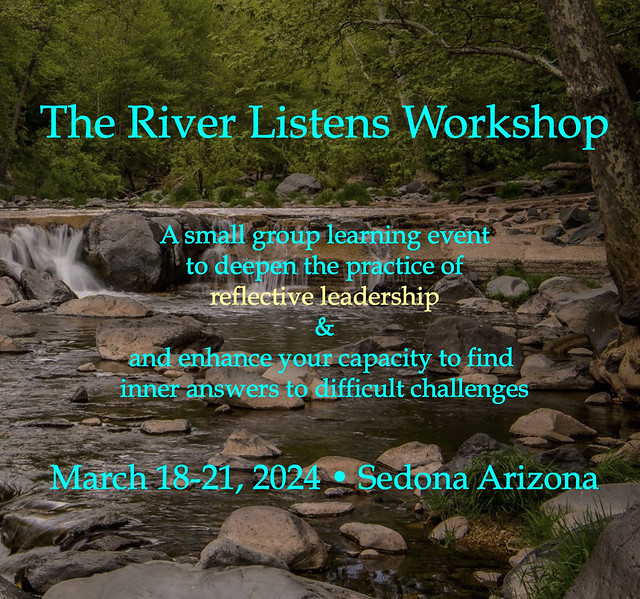
If you are interested in refining your capacity to find inner answers to challenging dilemmas, you may be interested in “The River Listens Workshop,” held in March 2024 in Sedona, Arizona. You can find out more about this small group learning event by accessing this downloadable pdf brochure.

I love your insightful piece, Dan.
Your article leads me to the notion of transformation. For me, the notion of “no going back.” I believe change allows for recidivism; transformation, not so much — I’m not the person I used to be, in thought, word, action, beliefs, stories, perceptions…
I’ve witnessed people undergo such transformative changes in various life aspects. Some have sought sobriety, completely altering their lives and leaving behind the shackles of addiction. I’ve seen people change their worldviews, shifting from prejudice and bias to acceptance and understanding.
For me, these transformative experiences, however, aren’t an instance of a fleeting thought. They root deeply in a person’s soul and are felt at a level that transcends cognitive comprehension. What I referred to as ‘right knowing,’ ‘right understanding,’ and ‘right action’ emerge from a place less about intellectual cognition and more about a felt sense, a deep resonance within one’s soul. It’s akin to an inner compass, guiding us toward our true essence and integrity. The Buddhists have a Koan, “What was your face like before you were born?” It’s like “right knowing,” “right understanding” and “right action” come from a “me” that has no history, memory, or experience, from the “me” who has not been was not influenced by past history, memory or experience
I think this transformation speaks to the power of self-awareness and the courage to face one’s fears fully. To leap into the unknown—not knowing if the other side holds a garden or a desert—is an act of immense bravery. It requires us to let go of our old selves, and our familiar patterns (habits, ways of being and doing and thinking…) and step into a new reality where there is no turning back. This is the true essence of thinking for oneself, a journey that isn’t without trepidation but one that ultimately leads to growth and transformation. I can find new solutions, challenge the status quo, and break free from societal expectations. It’s about being able to critically analyze information and form our own opinions, rather than blindly accepting what others tell us. There’s the courage and strength that comes from this inner “right knowing,” “right understanding,” and “right action.”
By thinking for our self, we can question and challenge existing systems, beliefs, and structures. We can advocate for change and pave the way for a more inclusive and progressive society. Independent thinking also empowers us to be leaders, rather than followers, as we have the confidence to stand by our convictions.
However independent thinking does not mean rejecting all external influences. It simply means being able to critically evaluate information and decide what aligns with our values and beliefs. It’s about seeking diverse perspectives, being open to new ideas, and engaging in healthy debate and discourse. This not only enriches our thinking but also allows us to understand others better, especially our self.
Change, transformation….simple, not easy.
Beautifully stated, Peter. The moment we know we cannot go back if we choose to go forward is like lighting a match. Either the whole house goes up in flames or…we blow out the match.