My client struggles to put a life together.
A vice-president, 48 years old, he treats his existence like a balance sheet, or rather a series of potential balance sheets, because in the moment things are out of balance. He has a good job with hopes of advancement, yet no partner, lives in a cold city he doesn’t like a long way from family, nurses chronic health issues without even the dog he’s always wanted to keep him company.
He thinks about change as a series of potential trade-offs. “If I look for a partner,” what happens if I do meet somebody but then decide to move to a warmer climate? I’ve wasted her time. And besides, given my job, I really don’t have time to look…”
“Maybe I’d just like to quit and travel for a year. I’ve always wanted to do that, but then I’d probably have to go back to work sometime so I’d want enough money saved to carry me through a period where I was looking for a job. So this isn’t something I could do right away. It would take me awhile to get there.”
“Maybe I’d need a million dollars, but if I saved that much, maybe I’d just end of saying to myself, ‘Well I might as well keep at it until I had two million.’ ”
All very reasonable, very pragmatic in a certain way. And painful. A balance sheet without a home.
I ask myself privately, “Why do some of us, especially men, have trouble feeling our feelings?”
That’s a question that could get some debate, but the debate itself might well itself be an example of the problem, an intellectualized cultural cue-de-sac from which there is little chance of escape if the life you are currently living is just comfortable enough to keep it as it is. Personally, it sounds like a good definition of hell, a kind of tragic, banal place representing the loss of all that is fresh, original, transient, beautiful, meaningful, fragile, sweet.
I read my client “The Journey” by Mary Oliver, a poem he doesn’t know, that includes the iconic lines:
"But little by little,
as you left their voices behind,
the stars began to burn
through the sheets of clouds,
and there was a new voice
which you slowly
recognized as your own,
that kept you company
as you strode deeper and deeper
into the world,
determined to do
the only thing you could do—
determined to save
the only life you could save."
He likes the poem and acknowledges its hard for him to give himself a break, to reward himself, to allow himself credit for what he’s done.
I have other clients who have given their lives to their organizations and to their work in similar ways, as if that is more or less the point of their existence. They also frequently have family issues and health problems. And it makes you wonder what it is that is more important than family or personal health and that so easily tramples the obvious boundaries. Money, accomplishment, self-expectations locked into a life style? A need for self-acceptance? Belonging? Some combination that whispers on the edge of consciousness that this performance is the only way and you’re lucky to have it? If this type of life is the answer, what kind of questions, indeed, are we asking ourselves?
I am here on the edge of the field
watching how the days go by
listening to the voices that any time
tell me what to do and when
and so at times I turn to face them
and to weep for the waste of it
call bullshit on the terms that
I accepted long again, the contract
I signed but can no longer find
hidden somewhere in the drawers
of paper I've left behind --
what now I cry to no one I know
what now what now
echos in darkness
what now
It may be that it takes hearing those echoes for a while before a person can turn and truly stop, fully challenge what is in front of them, this seemingly immense “buddha in the road.” The irony is that it may not be something very strong and powerful and heroic that best helps one clear the path. It is often just the smallest thing, something as sweet as a kind word or the acceptance of a little self-determined redemption, or maybe just a moment blessed by the smell of violets rising from the cold earth.
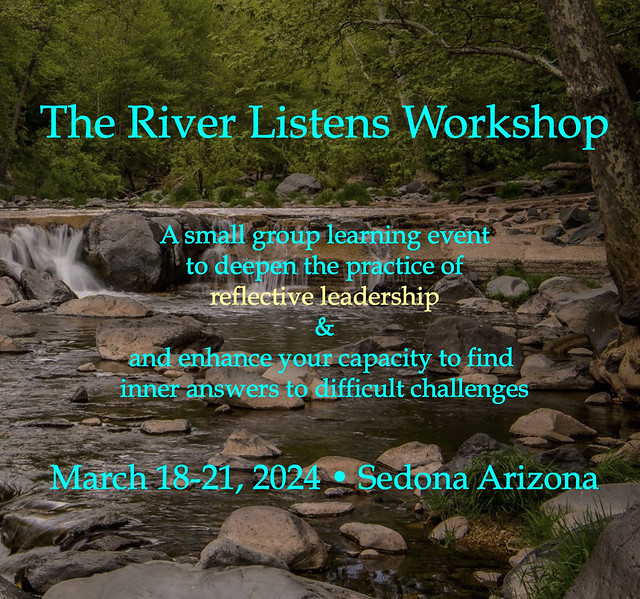
If you are interested in refining your capacity to find inner answers to challenging dilemmas, you may be interested in “The River Listens Workshop,” held in March 2024 in Sedona, Arizona. You can find out more about this small group learning event by accessing this downloadable pdf brochure.

A wonderful article, Dan, which touches me deeply. I see parts of myself that existed at various points in my life, in the individual you initially describe at the outset. For me, he is an “Everyman.”
His struggle with disconnection from his emotions, overemphasis on pragmatism, and perceived lack of control over his life’s direction are, for me, universal issues that many adults grapple with. His experiences reflect common societal pressures to conform, achieve, and suppress emotional needs for the sake of appearance. I think his story and struggles could be seen as representative of a vast number of folks’ experiences.
As a coach who focuses largely on the spiritual (not religious, not theological), and psycho/emotional foundations of behavior, I might infer that these adult attitudes may stem from his childhood experiences and environmental influences that prioritized achievement and conformity over emotional awareness and self-exploration, environments that value performance and accomplishment over emotional well-being. Coupled with a lack of emotional education — not being taught or encouraged to understand and express feelings — such a child can often grow into an adult who struggles to connect with their feelings or even recognize them.
Too, the mention of a “contract I signed but can no longer find,“ for me, hints at a subconscious belief system formed during childhood…indicating a family culture that implicitly enforced certain ‘rules’ about life, such as the necessity to secure a well-paying job, accumulate wealth, or suppress emotional needs for the sake of maintaining appearances.
Also, the lack of close-knit family ties and his location in an undesired city suggest experiences of isolation and dislocation, which could have roots in their early life. Perhaps he had to adapt to being self-reliant at a young age, leading to a sense of detachment and difficulty in forming close relationships in adulthood.
Good for you, Dan. In this article and others, you have written to encourage folks to honestly and openly explore and discuss feelings and emotions, thus prioritizing mental health and well-being, while challenging societal norms that limit our potential for true fulfillment and happiness. You do such good work supporting others to break free from the constraints of an “Everyman” existence and create one’s own unique, authentic paths in life
Thanks so much for your article. I wish you all the best with your workshop. The world is certainly a much better place because of your presence upon it.
Hello Dan,
Thank you for sharing another enlightening post. I perused it quickly when you first posted it, but wanted to wait until this weekend when I could devote all of my attention to it after completing my work documentation on some patients.
Although I am not a man, I have been a widow for many years and 100% financially responsible for my survival needs. I find that because of this, I cannot afford the ‘luxury’ of allowing emotions to completely interfere with my ability to perform my job so I have learned how to put things on the backburner until I’m in a place/space where I can check in with what I’m feeling and experiencing. I cannot speak for anyone else, but it seems in certain fields, such as healthcare, there are systemic issues that interfere with the average employee’s ability to create work/life balance. I have been attempting to be more proactive and intentional with what little time I have outside of work to devote to things that really matter to me.
And since October 7, world events have also added to the emotional stress of daily living. Hence, the reason I finally wrote my own post after nearly a decade last week to share my own desire to cultivate peace in the midst of it all.
Thank you for your contributions to helping the world navigate the often-turbulent waters of existence.
Kind Regards,
Samantha
Peter~
As always, thank you for your insightful comments and understanding of my work. You wrote, “You do such good work supporting others to break free from the constraints of an ‘Everyman’ existence and create one’s own unique, authentic paths in life.” That’s an accurate assessment of what I see the work to be and is especially so if we consider ‘Everyman’ as representing any unconscious side of who we are, influenced by all the factors you mention in your gracious interpretation. I write more or less intuitively and it is really great to get your view. Much appreciation to you! ~Dan
Samantha~
Thank you so much for joining in! It’s great to hear your voice again here.
I do a lot of work in health care environments and it is clear that current systems often work against a reasonable work/life balance. That’s a very long term cultural issue. In the meantime, beyond the sheer financial effects, to leave a job in health care right now because of overwork or bad management can cause people to feel guilty, as if this is some kind of personal betrayal of their colleagues and co-workers. Not good. On the other hand staying in does set people up to engage in forms of emotional suppression that are also not good and are detrimental to the person’s health in other ways. It’s a double-bind — one I’m guessing you are highly aware of. When working with people in this situation, my approach is to help make as much of that double-bind conscious as possible and to help a person see how much poison they have swallowed that comes from their own past individual conditioning. A person might choose to leave or to stay, but they ought to be able to do so without feeling hijacked or victimized by the system or their own hearts and minds. I don’t know how to help except to bring forward with the client as much reality and truth combined with care and love as possible and then let the client choose their own best path — which is what it sounds like you have had to do yourself.
Again, thank you so much for writing! And thank you, too, for your most beautiful post.
All the best
~Dan